

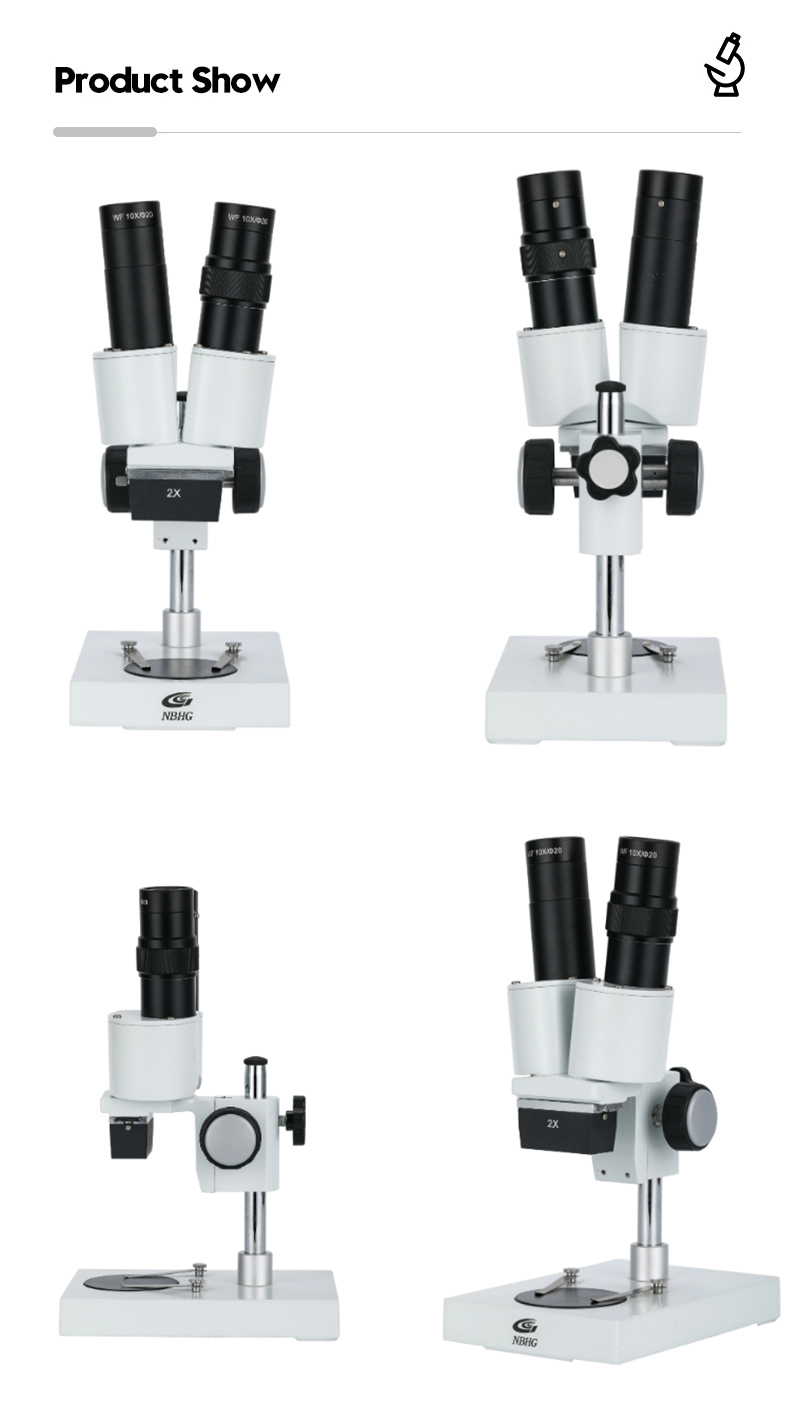
90 Degrees Mini Microscope Binocular Head Stereo Microscope for Compact 3D Inspection
When I design or recommend a stereo microscope for close inspection work, I do not look at magnification alone. In real production, the way an operator sits, how easily the sample can be reached, how stable the focus feels, and how naturally the eyes see the object are just as important. That is exactly where our 90 Degrees Mini Microscope Binocular Head Stereo Microscope comes into the picture.
At Ningbo Huaguang Precision Instrument Co., Ltd., we develop and manufacture optical instruments for education, Industrial Inspection, Jewelry Inspection, laboratories, repair work, and other precision applications. From our experience with microscopes and optical components, we have found that a compact microscope head can make a big difference when working space is limited. A 90-degree binocular viewing arrangement gives the operator a practical observation position while keeping the microscope compact and easy to integrate into a working station.
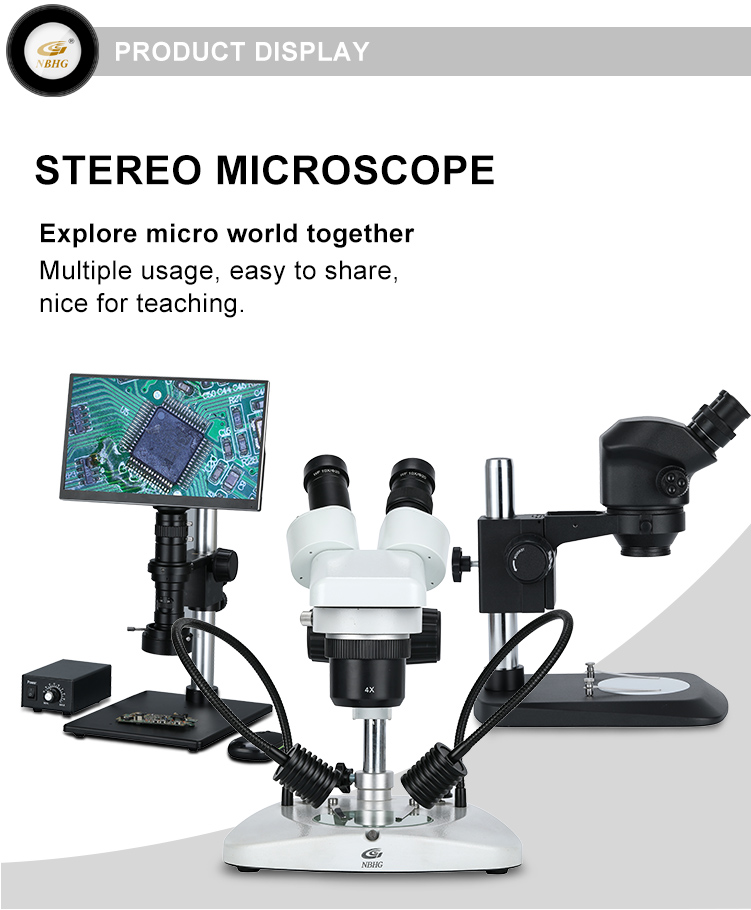
Our 90 Degrees Mini Microscope Binocular Head Stereo Microscope is built around a simple idea: make small objects easier to see without making the inspection process complicated. It provides binocular stereo observation, stable focusing, and a clear view of surface details. It can be used for electronics assembly, jewelry inspection, precision components, medical equipment inspection, education, laboratory work, repair, and quality control.
I also understand something that is easy to overlook when buying an optical instrument: the microscope is only one part of the complete inspection system. The objective, eyepieces, illumination, working distance, stand, accessories, operator position, and application all affect the final result. For this reason, we discuss the actual application before confirming a configuration instead of treating every order as exactly the same.
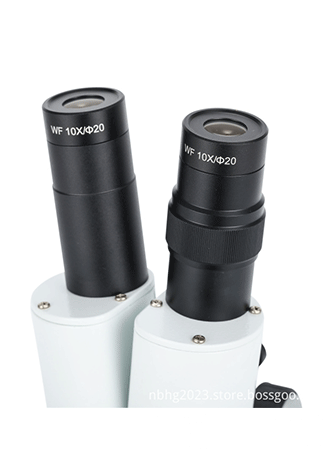
A stereo microscope is different from a standard Biological Microscope. Instead of looking at a very thin specimen through a single optical path, a stereo microscope uses two viewing paths so the operator can see the object with a stronger sense of depth. This makes it especially useful for objects that have height, edges, holes, curves, solder joints, surface marks, or other three-dimensional features.
For example, when I inspect a small metal component, simply making the image larger is not enough. I also want to know whether a corner is raised, whether a scratch is on the surface, whether a solder joint has the expected shape, or whether two Small Parts are properly aligned. A stereo view makes these details much easier to understand.
The 90 degrees binocular head is particularly interesting for compact workstations. Instead of forcing the operator to look straight through a conventional microscope tube, the viewing direction is arranged at approximately 90 degrees. This can be useful when the microscope body needs to fit into a restricted area or when the operator's working position needs to be separated from the direction of the main optical body.
The word “mini” is also important here. A compact microscope head can be easier to install into inspection equipment, teaching equipment, repair benches, jewelry workstations, or customized optical systems. It does not mean that the microscope is intended only for simple work. In practice, compact optical equipment can be very useful when the surrounding workspace is already crowded.
For production users, this matters because the microscope should work with the operator, not against the operator. A clear image, smooth focus, comfortable binocular observation, and sensible mechanical design can reduce unnecessary movement during repeated inspection tasks.
| Feature | Why It Matters in Actual Inspection | Typical Application |
|---|---|---|
| Binocular stereo observation | Helps the operator understand surface shape and depth | Parts inspection, assembly, jewelry |
| 90-degree viewing arrangement | Provides an alternative observation position for compact setups | Customized workstations, repair stations |
| Compact microscope head | Helps save installation space | Laboratories, production benches, teaching systems |
| Stable focusing | Makes repeated observation easier | Quality control and assembly |
Source note: The application relationship between stereo microscopes, surface inspection, manufacturing quality assurance, circuit board work, and delicate manual work is consistent with published guidance and application information from ZEISS and Nikon. :contentReference[oaicite:0]{index=0}
I prefer to explain microscope optics in plain language because the basic principle is actually quite easy to understand.
When both eyes look at the same object from slightly different optical paths, the brain combines those two views. The result is a stronger feeling of depth than you normally get from a flat image. This is the basic reason a stereo microscope is useful for three-dimensional inspection.
Inside the microscope, the optical system collects light from the sample and forms magnified images for the two viewing paths. The operator then adjusts the focus until the required surface detail appears sharp. Depending on the selected optical configuration, the microscope can be set up for different levels of magnification and different working distances.
This is why I do not recommend choosing a microscope only by asking, “How many times does it magnify?” A very high magnification number sounds impressive, but it is not automatically better for every application. If the field of view becomes too small, the operator may have difficulty locating the area that needs inspection. If the working distance becomes too short, there may not be enough room for tweezers, soldering tools, repair tools, or other equipment.
Working distance means the practical space between the objective lens and the sample when the image is in focus. Nikon's published stereo microscope specifications show how different optical configurations can provide different working distances. For example, the SMZ445/SMZ460 series lists a 100 mm standard working distance, while auxiliary objectives can extend this to 127.5 mm or 181 mm. :contentReference[oaicite:1]{index=1}
That is a useful lesson when selecting our 90 Degrees Mini Microscope Binocular Head Stereo Microscope. The correct configuration depends on what the user actually needs to do underneath the lens.
| Optical Parameter | What the Operator Experiences | Why It Should Be Considered |
|---|---|---|
| Magnification | How large the object appears | Important for small details and fine inspection |
| Working distance | Available space between lens and sample | Important when tools or hands need to work under the microscope |
| Field of view | How much of the sample can be seen at once | Important for locating and checking larger areas |
| Binocular viewing | Two-eye observation with depth perception | Useful for three-dimensional parts and manual work |
Source: Nikon published specifications for stereo microscope systems demonstrate the relationship between magnification, optical configuration, eyepieces, auxiliary objectives, and working distance. :contentReference[oaicite:2]{index=2}
The 90-degree binocular head is the defining feature of this microscope. It changes the relationship between the operator, the optical head, and the sample. In a compact inspection station, this can be more convenient than using a conventional straight observation arrangement.
For engineers designing custom inspection equipment, the orientation of the optical head can be just as important as the optical specifications. A microscope may have excellent optics, but if its physical arrangement does not fit the equipment, the optical performance does not solve the installation problem.
Two-eye observation is helpful when the surface has real three-dimensional structure. Small screws, connectors, circuit boards, jewelry settings, machined parts, plastic components, and medical equipment components are not perfectly flat objects. Being able to judge height and surface shape makes inspection more natural.
ZEISS describes stereo microscope objectives as being suitable for large or structured samples, surface studies, delicate work, circuit board manufacturing and quality assurance inspections. :contentReference[oaicite:3]{index=3}
Many customers do not have a large laboratory table available. A repair bench may already contain tools, fixtures, lighting, test equipment, trays, and electronic devices. A compact microscope head helps leave more room for the actual work.
This is particularly useful in repair and assembly applications where the operator needs to move the sample or tools frequently. The microscope should provide magnification without becoming the biggest object on the workbench.
Stable focusing is one of those features that sounds ordinary until you use a microscope for several hours. If the focus mechanism feels inconsistent, the operator spends more time adjusting the image and less time checking the part.
For repeated quality control work, smooth mechanical movement is especially useful. I pay attention to the interaction between the optical head, focusing mechanism, stand, and sample position because these parts work together as one inspection system.
Different users need different optical combinations. A jewelry inspector may care about fine surface details. An electronics assembler may need enough working distance for a soldering tool. A school laboratory may prioritize simple operation and easy observation. A production line may need a configuration that fits a specific fixture.
For that reason, the production cycle and final configuration of our microscope can vary according to the model, optical setup, accessories, order quantity, and customization requirements.
I see this type of microscope as a practical tool for many small-object inspection tasks rather than a device limited to one industry.
Electronics work is one of the most natural applications. Operators may need to inspect solder joints, connectors, wires, component placement, PCB surfaces, and small mechanical parts. A stereo microscope gives the operator a magnified view while retaining a sense of depth.
For production environments, working distance becomes important because inspection may happen alongside tweezers, probes, soldering tools, or other small instruments. Nikon also lists circuit board manufacturing and Industrial Quality Inspection among Stereo Microscope Applications. :contentReference[oaicite:4]{index=4}
Jewelry requires a different kind of attention. The inspector may need to check stone settings, polishing marks, scratches, small gaps, metal surfaces, or decorative details.
Here, a clear binocular image is valuable because jewelry is full of curved and reflective surfaces. The operator needs to see not only whether a mark exists, but also where it sits on the surface.
Small machined components often contain holes, grooves, edges, threads, and contact surfaces that are difficult to inspect with the naked eye. A stereo microscope can provide a closer look without requiring the part to be cut or heavily prepared.
This can make the microscope useful for incoming inspection, process inspection, repair, and final quality checks.
Small components used in medical equipment can require careful visual inspection. The exact application and regulatory requirements should always be evaluated according to the final equipment and intended use, but optical inspection itself is a common reason for using stereo microscopy.
For education, stereo microscopes are useful because students can observe objects that have real depth rather than only viewing thin prepared slides. The operation can also be easier to understand for beginners because the sample can be physically manipulated under the microscope.
Repair work is another area where compact stereo microscopes make sense. When I am repairing a small component, I want both hands available while keeping the inspection area visible. A practical working distance and comfortable viewing position can make the whole job easier.
| Industry | Typical Inspection Target | Useful Microscope Characteristics |
|---|---|---|
| Electronics | Solder joints, PCB components, connectors | Binocular view, stable focus, suitable working distance |
| Jewelry | Settings, surfaces, stones, polishing details | Clear stereo image and fine observation |
| Precision machinery | Machined edges, holes, grooves, small parts | Depth perception and stable focusing |
| Medical equipment | Small assemblies and components | Controlled observation and repeatability |
| Education | Three-dimensional samples | Simple binocular observation |
| Repair | Small damaged or assembled parts | Compact layout and practical working space |
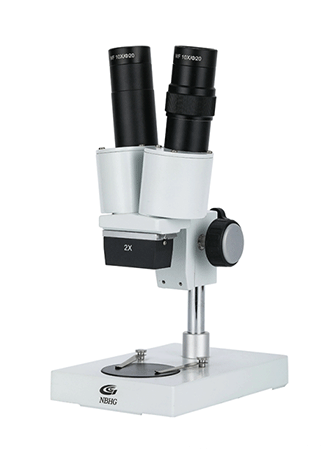
At Ningbo Huaguang Precision Instrument Co., Ltd., I believe the manufacturing process should be connected directly with the customer's final use. A microscope is not just a collection of lenses and mechanical parts. Optical quality, mechanical stability, assembly accuracy, cleanliness, and packaging all influence the experience after delivery.
Our company is located in Haishu District, Ningbo, where transportation is convenient for domestic and international logistics. We focus on educational microscopes, industrial inspection microscopes, professional jewelry inspection microscopes, optical components, and precision injection molding.
During production, the exact process depends on the microscope configuration. Optical components must be prepared and assembled according to the selected design. Mechanical parts need appropriate dimensional control so the optical system and focusing mechanism can work together correctly. Assembly also needs attention to cleanliness because dust or contamination inside an optical instrument can directly affect the viewing experience.
Before shipment, we check the important parts of the completed microscope. Our inspection process covers optical performance, focusing operation, mechanical operation, accessories, appearance, and overall assembly quality. The goal is simple: the microscope that leaves our facility should match the agreed configuration and be ready for its intended use.
We also understand that international shipping is not the same as moving a microscope across a workshop. A precision instrument can experience vibration, handling, temperature changes, and pressure during transportation. We therefore use cushioning and dust-proof materials, place each microscope in an individual box, and then use reinforced export cartons for international shipments.
Our products are exported to more than 20 countries and regions, including the United States, Brazil, Germany, the Netherlands, and Japan. This international experience has taught us to pay attention not only to the microscope itself, but also to documentation, packing, communication, and delivery arrangements.
Our company has also been certified to the ISO 9001 quality management system, while our products have been certified to CE and RoHS according to the applicable product requirements. ISO explains that ISO 9001 provides a framework for establishing, maintaining, and continually improving a quality management system; the current international edition is ISO 9001:2026, published in September 2026. :contentReference[oaicite:6]{index=6}
One of the most common mistakes when purchasing a microscope is choosing a model name first and asking technical questions later. I prefer to reverse that process.
First, I want to know what the customer is inspecting. Then I want to know the approximate size of the sample, the smallest detail that needs to be seen, whether the operator needs to use tools under the lens, how much table space is available, and whether photography or digital imaging is required.
Only after these points are clear does it make sense to discuss magnification, eyepieces, objectives, working distance, illumination, stand type, and accessories.
This approach is supported by the way professional microscope manufacturers publish their specifications. Nikon's stereo microscope range, for example, shows that total magnification can depend on the combination of eyepieces and auxiliary objectives rather than being a single fixed number. Its SMZ745 specification lists a 3.35–300x total magnification range depending on eyepiece and auxiliary objective selection, while its standard working distance is 115 mm. :contentReference[oaicite:7]{index=7}
Another Nikon system, the SMZ1270, lists a 0.63–8x zoom range and a total magnification of 3.15–480x depending on eyepieces and objectives, with a 70 mm working distance under its specified configuration. :contentReference[oaicite:8]{index=8}
These numbers are not meant to suggest that one microscope is suitable for every job. They show something more useful: microscope performance should be discussed as a complete optical system.
| Published Stereo Microscope Example | Zoom Range | Total Magnification | Working Distance |
|---|---|---|---|
| Nikon SMZ445 | 0.8–3.5x | 8–35x standard | 100 mm standard |
| Nikon SMZ460 | 0.7–3.0x | 7–30x standard | 100 mm standard |
| Nikon SMZ745 | 0.67–5x | 3.35–300x depending on configuration | 115 mm standard |
| Nikon SMZ1270 | 0.63–8x | 3.15–480x depending on configuration | 70 mm with specified 1x objective |
Source: Nikon published product specifications for the SMZ445/SMZ460, SMZ745, and SMZ1270 stereo microscope families. These are reference products from another manufacturer and are provided only to illustrate how optical configurations can vary; they are not specifications of our 90 Degrees Mini Microscope Binocular Head Stereo Microscope. :contentReference[oaicite:9]{index=9}
I know that buyers of optical instruments usually want more than a product photograph and a price. They want to know whether the supplier understands the application, whether the configuration can be adjusted, whether quality checks are actually carried out, and whether someone will respond when a technical question appears after delivery.
That is why our work covers more than microscope assembly. Our company is engaged in the production of educational microscopes, industrial inspection microscopes, professional jewelry inspection microscopes, optical components, and precision injection molding. This gives us experience across both optical and mechanical manufacturing.
We also develop different series of nanometer photocatalytic air purifiers and air-conditioning purification equipment. While these products are different from microscopes, the underlying manufacturing mindset is similar: understand the application, control the production process, test the finished product, and keep improving.
Our products have been supplied to customers in more than 20 countries and regions. International customers often have different requirements for documentation, packaging, logistics, electrical standards, and product configuration. We therefore confirm these details during the order process instead of leaving them until the shipment is ready.
For the 90 Degrees Mini Microscope Binocular Head Stereo Microscope, I am particularly interested in understanding the installation environment. If you are using it as part of a customized inspection machine, the available space and viewing direction can be more important than simply asking for the highest magnification.
Our company follows the working principle of continuous improvement. Our credo is “Nothing is perfect only better and better.” In practical terms, that means we keep looking at optical design, mechanical structure, product stability, production control, customer communication, and after-sales service rather than treating a finished product as the end of the process.
For standard models, the production cycle can usually be arranged more quickly. Customized configurations may require additional time for optical confirmation, accessory matching, production, assembly, and inspection. Before placing an order, I recommend confirming the model, optical configuration, accessories, quantity, destination, packaging requirements, and required documents.
Payment is arranged according to the agreed order terms, commonly using a deposit and balance before shipment. Depending on the destination and delivery schedule, transportation can be arranged by air freight, sea freight, express delivery, or another suitable logistics method.
It is a compact stereo microscope using a binocular viewing head arranged at approximately 90 degrees. It is designed to provide three-dimensional observation of small objects while offering an alternative viewing position for compact inspection setups. The exact optical and mechanical configuration depends on the selected model and application.
The main advantage is that the operator can use both eyes to observe a three-dimensional object. This makes it easier to understand surface shape, height, edges, holes, and other physical features than simply looking at a flat enlarged image.
Yes. Stereo microscopes are widely used for electronics assembly and PCB inspection. Typical tasks include checking solder joints, connectors, component placement, wires, and small mechanical features. The final configuration should be selected according to the required detail size and working distance.
Yes. A stereo microscope is well suited to jewelry inspection because jewelry contains three-dimensional surfaces and very small details. It can be used for checking settings, polishing marks, scratches, edges, stones, and other fine features.
No. Higher magnification is not automatically better. When magnification increases, the visible field can become smaller and the working area can become more restricted. For production work, the right balance between magnification, field of view, working distance, image clarity, and operator comfort is usually more useful than simply selecting the largest number.
I recommend providing the sample type, approximate sample size, smallest detail that needs inspection, preferred working distance if known, expected magnification, available installation space, whether illumination is required, whether a camera is needed, quantity, and destination country. If you can provide photos of the sample or the existing inspection setup, that is even better.
The production cycle depends on the microscope model, optical configuration, accessories, order quantity, and customization requirements. Standard configurations can normally be arranged faster, while customized orders may need additional time for technical confirmation and production.
Before shipment, we check optical performance, focusing, mechanical operation, accessories, appearance, and overall assembly quality. We also confirm that the delivered configuration matches the agreed order requirements.
Each microscope is protected with cushioning and dust-proof materials and packed in an individual box. The individual package is then placed into reinforced export cartons. This structure helps reduce the risk of damage during handling and international transportation.
We can discuss customized requirements according to the application. The feasibility depends on the required optical system, mechanical structure, accessories, installation conditions, order quantity, and other technical details. We normally confirm these points before giving a final production schedule.
The delivery package can include the agreed microscope configuration, accessories, user documents, and applicable inspection or certification documents. The exact documents depend on the product configuration and order requirements.
When I look at the 90 Degrees Mini Microscope Binocular Head Stereo Microscope, I see it as a practical optical tool for situations where clear three-dimensional inspection and compact installation both matter.
The most important point is not simply the microscope's magnification. It is whether the optical configuration matches the work. A good inspection microscope should allow the operator to see the required detail, reach the sample comfortably, focus without unnecessary adjustment, and work naturally for the intended inspection period.
That is how we approach microscope manufacturing at Ningbo Huaguang Precision Instrument Co., Ltd. We combine optical instrument production, optical component experience, precision injection molding, quality management, inspection, export packaging, and customer support to build products for real working environments.
If you are looking for a 90 Degrees Mini Microscope Binocular Head Stereo Microscope for electronics inspection, jewelry inspection, precision machinery, laboratory work, education, repair, or a customized inspection station, the first step is to match the microscope with your actual sample and workspace. Once those details are clear, we can discuss the appropriate optical configuration, accessories, production schedule, inspection requirements, and delivery method.
For us, the goal is straightforward: provide a microscope that is clear to look through, practical to work with, stable in daily use, properly checked before shipment, and supported by a manufacturing team that continues to improve with every project.
 RELATED
Add: No.70 Zhenxing East Road, Zhangshui Town,Haishu District,Ningbo City,Zhejiang,China
Contact Person: Mr. Xu Contact Number:+86 13777211956
Tel:+86 574-88152588/574-88152566
Fax:+86 574-88152570
Post Code:315161
E-mail:chinahg@hgopt.com

This website uses cookies to ensure you get the best experience on our website.
 中文
中文


 WhatsApp
 Phone
Phone E-mail
 Message